Veteran Wildland Fire Leader Julie Molzahn Brings Decades of Fireline Experience to Running Through the Fire

Sep 22, 2026

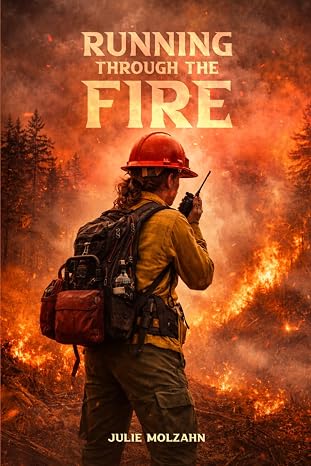
A powerful novel of survival, sacrifice, family, and enduring love takes readers beyond the headlines and into the human heart of wildland firefighting


Airway Heights, Washington Sep 22, 2026 (Issuewire.com) - Few people understand the intensity of a wildfire from the inside. Julie Goodspeed Molzahn does. After more than three decades of service with the U.S. Forest Service and years spent working directly on the fireline and with Incident Management Teams, Molzahn brings a lifetime of firsthand knowledge to her novel, Running Through the Fire: Annie's Story of Fire, Family and Love.

Blending contemporary romance with the danger, urgency, and sacrifice of wildland firefighting, Running Through the Fire follows Annie, a woman whose life has been shaped by fire, family, duty, and a bond formed long before either she or her childhood best friend, Cole, understood where their lives would lead.

Annie grows up surrounded by boys, with Cole occupying a special place in her life from childhood. While Cole pursues a future in football, Annie follows a very different calling and becomes a wildland firefighter. Their paths separate as ambition, disappointment, and the choices of adulthood pull them in different directions.

Years later, Annie has risen to become a Fire Chief with extensive experience battling wildfires across the United States. When the devastating Bench Fire threatens towns and traps families in its path, she is placed at the center of a rapidly unfolding disaster.

The emergency becomes intensely personal as Annie confronts burning homes, endangered communities, and children who need to be rescued before time runs out. Meanwhile, Cole watches the crisis unfold and recognizes the firefighter risking everything to save others as the childhood friend he once allowed to walk out of his life.

What follows is more than a story about surviving a wildfire. It is a story about recognizing what matters when everything familiar can disappear in an instant.

Molzahn gives the novel an authenticity rarely possible from research alone. She dedicated more than 35 years to the U.S. Forest Service, serving in roles that ranged from local ranger districts to national leadership. Her career encompassed fire, fuels, timber, recreation, planning, research, conservation education, and climate change.

Her experience also includes 18 years of direct work on the fireline, where she reached Strike Team Leader status, along with 30 years serving on Incident Management Teams in logistics, planning, and incident information. For a decade, she served as a Line Officer on large fires, participating in the difficult decisions that must be made when communities, resources, and lives are at risk.

That experience gives Running Through the Fire its distinctive foundation. Behind the fictional characters lies an understanding of incident command, evacuation, dangerous fire behavior, field decision-making, and the physical and emotional demands placed upon the people who confront major fires.

Yet Molzahn does not lose sight of the people inside the uniforms.

Her novel explores the courage required not only to enter danger but also to live with loss, disappointment, responsibility, and unresolved love. Annie's strength is not presented simply through the risks she takes. It is also revealed in the choices she makes, the people she protects, and the life she continues to build after painful experiences.

At its heart, the book asks what survives when certainty disappears.

For Molzahn, writing the novel also offered an opportunity to honor a community that has remained important to her throughout her life and career. As she explains on her website, her heart remained with the crews working on the ground even as her career carried her into national leadership positions.

That commitment extends beyond the pages of the novel.

Proceeds from Molzahn's books will be donated to the Wildland Firefighter Foundation, an organization dedicated to supporting wildland firefighters and their families during injury, tragedy, hardship, and long-term recovery. Through this connection, a story inspired by years of service becomes another way to support the people whose lives are touched by the realities of wildland fire.

For readers, Running Through the Fire offers several stories at once. It is a romance shaped by years of separation and unfinished feelings. It is a survival story set against the unpredictable force of wildfire. It is a tribute to the men and women who protect communities when conditions become dangerous. Most importantly, it is a story about resilience and the relationships people discover are worth fighting for.

Julie Goodspeed Molzahn is a graduate of Iowa State University, where she earned degrees in Forestry Management and International Studies. In addition to her Forest Service career, she has supported charitable and community organizations focused on youth sports, military families, and conservation. She is a mother of six and grandmother of eight.

Running Through the Fire: Annie's Story of Fire, Family and Love is available in paperback, hardcover, and digital editions through major booksellers, including Amazon and Barnes & Noble.

To learn more about Julie Molzahn, her career, her writing, and Running Through the Fire, visit juliemolzahn.com.

Facebook

Instagram

Website

Media Contact

The Mystic Publisher


[email protected]

Source :https://juliemolzahn.com/

This article was originally published by IssueWire. Read the original article here.

More News
The Supreme Court is poised to make taxpayers fund anti-LGBTQ discrimination
Oct 27, 2026
The Supreme Court is poised to make taxpayers fund anti-LGBTQ discrimination

On November 3, the Supreme Court will hear St. Mary Catholic Parrish v. Roy, which squarely presents the question of whether the Constitution authorizes discrimination by religious schools. | Kent Nishimura/Los Angeles Times via Getty Images For years, the Supreme Court has flirted with the question of whether religious conservatives may simply ignore laws prohibiting discrimination against LGBTQ Americans. The Court’s Republican majority frequently rules in favor of business owners and institutions that refuse to serve gay or trans people. But these cases often rely on ad hoc reasoning that seems designed to give religious conservatives a narrow win without resolving broader questions about whether people with anti-LGBTQ religious views have an absolute right to violate civil rights laws. On November 3, however, the Court will hear St. Mary Catholic Parrish v. Roy, which squarely presents the question of whether the Constitution authorizes discrimination by religious schools. Given the Court’s past behavior in similar cases, it’s hard to imagine St. Mary ending in anything other than a victory for religious groups that wish to exclude sexual or gender minorities. The case also presents another, related question: When does the Constitution require states to subsidize religious institutions? The Republican justices’ recent decisions suggest that they are eager to make taxpayers spend a great deal more money to promote religion. The case concerns a Colorado law that pays for preschool education for all 4-year-olds in the state. Families with eligible children may choose from a broad range of private and public schools, including religious schools. But the state also bars schools that participate in this program from discriminating on the basis of sexual orientation or gender identity. Religious preschools that discriminate may continue to operate in Colorado. Although Colorado does have a broad ban on anti-LGBTQ discrimination, that ban exempts places that are “principally used for religious purposes.” So the sole issue in St. Mary is whether Colorado’s taxpayers must fund religious schools that engage in discrimination. Until fairly recently, the question of whether a state would fund religious education was up to the state itself. In 2002, the Court ruled in Zelman v. Simmons-Harris that states had broad leeway to decide whether to fund religious education. They could, if they chose to, set up private school voucher programs that include religious schools. But they could also choose only to fund secular education. In Carson v. Makin (2022), however, the Supreme Court abandoned this permissive approach. The case struck down a Maine program that offered private school tuition vouchers to students in sparsely populated areas where it was not cost-efficient for the state to operate a public school. Maine law provided that these vouchers could only be used at “nonsectarian schools,” but the Court’s Republican majority held that school voucher programs must include religious schools. The Colorado preschool program at issue in St. Mary, in contrast to the program in Maine, does not bar any school from participating because it teaches religion or is affiliated with a particular faith. The program merely requires all participating schools — be they Catholic, protestant, Jewish, Muslim, Hindu, or secular — to comply with an anti-discrimination law. The question in St. Mary, in other words, is whether religious schools can not only demand taxpayer funding, but also demand exemptions from generally applicable rules that apply to all other schools that accept that funding — essentially requiring taxpayers to pay for institutions that discriminate. The St. Mary plaintiffs want the Supreme Court to join together separate lines of religion cases The Court’s Republican majority has spent more than a decade remaking how the Constitution approaches religion — or, at least, rewriting the Court’s own precedents interpreting the Constitution’s provisions governing religious rights. One of those provisions guarantees everyone the right to “free exercise” of their own faith, while the other prohibits the government from creating an “establishment of religion.” Broadly speaking, the Court’s recent decisions have read the first provision expansively, while simultaneously reducing limits on the government’s ability to advance religion — or even holding that the government is constitutionally required to fund religious institutions. The St. Mary plaintiffs ask the Court to marry two branches of its recent religion decisions — one of which governs when people who object to a law on religious grounds are exempt from following it; the other asks when the government must fund religious schools. The first branch involves the Constitution’s free exercise clause, and this Court has fairly consistently held that, when the interests of religious conservatives conflict with LGBTQ Americans — or, really, anyone who takes a relatively liberal approach to sexuality — religious conservatives win. If you are a religious conservative, and you want an exemption from a law barring discrimination against LGBTQ people, this Court will make up a reason why you should win.  That said, while this Court consistently favors religious conservatives over queer people, the Court’s cases governing when a person of faith is exempt from a law that they object to on religious grounds are fairly incoherent and have not articulated clear legal rules. In Employment Division v. Smith (1990), the Court held that these exemptions are not available when someone challenges a “neutral law of general applicability,” meaning that the law applies with equal force to both religious and non-religious people or institutions. But Smith is, to put it mildly, not a beloved decision. Congress tried, semi-successfully, to overrule it when it enacted the Religious Freedom Restoration Act of 1993. And the Court’s most recent religion cases often read like the justices are looking for an excuse not to follow Smith.  In Masterpiece Cakeshop v. Colorado Civil Rights Commission (2018), for example, the Court ruled in favor of a Christian baker who refused to bake wedding cakes for same-sex couples. But the Court grounded that decision in facts very specific to the case, and Masterpiece Cakeshop offers judges little guidance on how they should decide other religion cases that don’t involve these unusual facts. Similarly, in Fulton v. Philadelphia (2021), the Court dodged a showdown over whether to overrule Smith and again resolved the case based on facts that were unique to that case. These are just two examples of the Court finding ways to not follow the rule it laid out in Smith, without overruling Smith or otherwise announcing a broad legal rule that governs free exercise cases. In their brief to the justices, the St. Mary plaintiffs list “at least eight different categories of cases where Smith does not control.” It appears that the Court has kept Smith in this strange limbo state — neither overruled nor followed in many cases — because several of the justices aren’t sure what legal rule should exist in its place. Indeed, in a concurring opinion in Fulton, Justice Amy Coney Barrett said outright that, while there are “serious arguments that Smith ought to be overruled,” she wasn’t yet prepared to do so because she wasn’t sure “what should replace Smith.” Still, the one thing that is clear from this Court’s recent precedents is that religious conservatives routinely prevail over LGBTQ Americans. The current Court has not disturbed decisions from the 1980s that held that religious business owners must pay taxes and comply with workplace regulations such as the minimum wage, but it consistently comes up with a reason to permit religious conservatives to engage in anti-LGBTQ discrimination whenever that issue comes up. That’s bad news for same-sex couples in Colorado, and a sign that the St. Mary plaintiffs are likely to prevail. The current crop of justices appear to be either unable or unwilling to come up with a coherent legal doctrine that can guide judges hearing religious liberty cases. The second line of cases at issue in St. Mary, meanwhile, deal with government subsidies. Nearly a quarter century ago, the Supreme Court held that states may fund religious education if they choose, but that they aren’t required to do so. The Court’s current majority, by contrast, handed down a series of decisions suggesting that separation of church and state is itself unconstitutional. These decisions culminated in Carson, which held that states that offer vouchers to pay for private school tuition must allow these vouchers to be spent at religious schools. So, realistically, there’s little chance that the plaintiffs in St. Mary will not succeed. If you accept both Carson and the Court’s decisions elevating religious conservatives over LGBTQ people, then it’s not like these plaintiffs’ argument is much of a stretch. It is nothing more than the logical next step in the Court’s broader efforts to shield religious conservatives from anti-discrimination laws, while also requiring nonbelievers to fund those conservatives’ schools. Carson established that a state violates the Constitution’s free exercise clause when it denies a government subsidy to a religious school. Meanwhile, the Court’s cases involving religious exemptions to the law are doctrinally incoherent, but the one theme that does unite them is that religious conservatives should not have to follow laws protecting LGBTQ people from discrimination. It is likely, in other words, that Colorado taxpayers will soon be constitutionally required to fund schools that refuse to serve the children of same-sex couples — or that otherwise engage in anti-LGBTQ discrimination that violates Colorado law. The Court is likely to hand down another ad hoc decision that doesn’t explain how judges are supposed to approach religious liberty cases One additional w

YOUR NEWS, OUR NETWORK.

Do you have Great News you want to tell the world?

Be it updates about your business or your community, you can make sure that it’s heard by submitting your story to our network reaching hundreds of news sites across 6 verticals.


Subscribe Now!

About Us

The Journalist Report publishes timely news updates around the clock. We have a group of journalists around the globe to deliver the latest news around so that we can get our users connected.